On Sunday, March 22, 2026, at approximately 11:40 p.m., Air Canada Express Flight 8646 collided with a fire truck as it landed on Runway 4 at New York’s LaGuardia Airport. The aircraft, a CRJ-900 model aircraft, was operated by Jazz Aviation, L.P., Canada’s largest regional airline. The flight originated from the Montreal-Pierre Elliott Trudeau International Airport in Montreal, Canada, with LaGuardia Airport in Queens, New York, as its final destination.
The flight was uneventful through landing. As the aircraft touched down on Runway 4, fire and emergency equipment were operating on the airport property. A fire truck from a Port Authority Police Department unit known as Truck One and Company contacted the Ground Air Traffic Controller (“Ground Control”) who is responsible for ground movement at the airport. The Aircraft Rescue and Firefighting Truck was responding to a call for assistance involving another aircraft, and asked permission to cross Runway 4 at the Taxiway D (Delta) intersection. Ground Control approved the request. However, at this time Flight 8646 had just landed on Runway 4 and was travelling at a ground speed of approximately 100 miles per hour. As the fire truck began crossing Runway 4, Flight 8646 collided with the truck. Although Ground Control initially approved the fire truck’s request to enter the active runway, the air traffic controller then realized that Flight 8646 was completing its after-landing roll out. Ground Control then attempted to stop the fire truck from crossing Runway 4, directing the truck to “Stop! Stop!” but it was too late and, being unable to stop in time, Flight 8646 collided with the fire truck. It is unknown at this time why Ground Control initially cleared the fire truck to enter and cross Runway 4 with an aircraft cleared to land on the same Runway but communications after the collision indicated that the Ground Controller realized his mistake. The communications between Ground Control and the fire truck can be heard HERE. To place these communications into context below is an airport chart depicting the location of the collision at taxiway D and Runway 4.
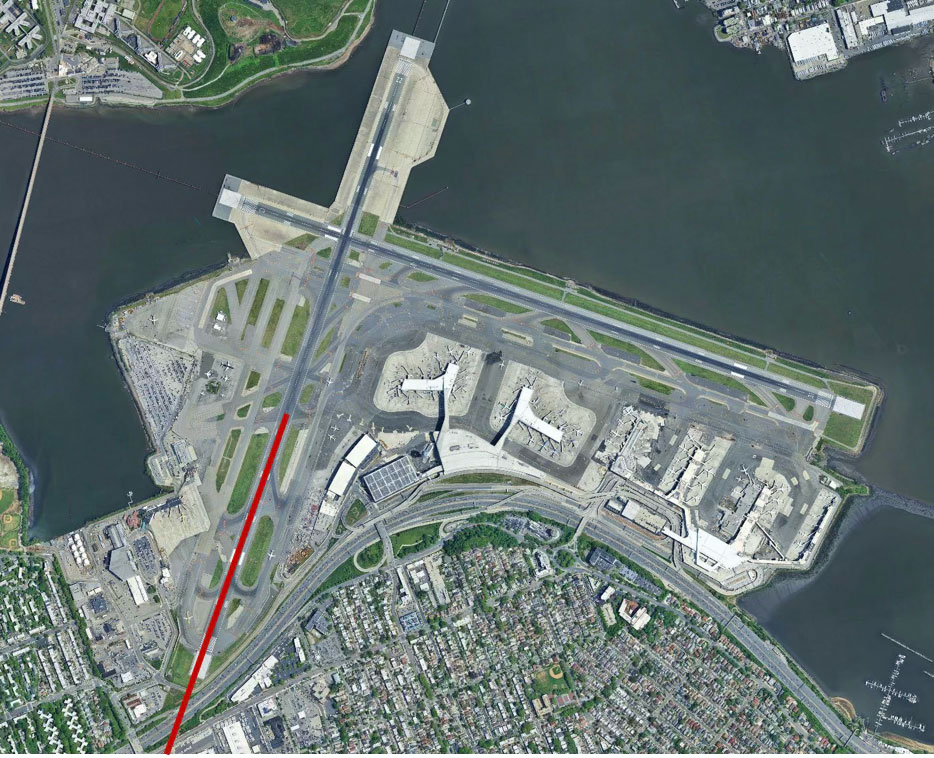
Aerial image from Google Earth
Tragically, the collision sheared the front part of the cockpit from the fuselage. The pilot and co-pilot were killed, and the flight attendant was ejected from the aircraft suffering severe injuries. There were a total of 76 individuals on board Flight 8646, consisting of 72 passengers, the 2-person flight crew and 2 flight attendants. Early reports indicate that 41 persons were initially hospitalized including two occupants of the fire truck, but 31 have since been released. Ten individuals remain hospitalized with severe injuries.
The National Transportation Safety Board (“NTSB”) will be the lead federal agency responsible for conducting the investigation. Parties to the investigation will be the airline, Jazz Aviation, the Federal Aviation, the unions representing pilots as well as the air traffic controllers and possibly the aircraft manufacturer. The NTSB will examine all aspects of the crash including the conduct of Air Traffic Control, the flight crew and the movement of the fire truck. This will include an analysis of the Airport Surface Detection System (“ASD”). The ASD Display is similar to ground radar that provides visual information to air traffic control about the movement of planes and other vehicles on the tarmac. In addition, the “Black Boxes” from Flight 8646 consisting of the Cockpit Voice Recorder and Digital Flight Data Recorder, both of which have been recovered by the NTSB, will shed additional light on the actions of the flight crew, whether the crew even realized that the fire truck entered the Runway, whether it was possible for the crew to undertake evasive action, and what actions the crew took in their attempt to avoid the collision. The NTSB will analyze all available data, including surveillance video which captured the tragic collision in rendering its Factual and Probable Cause findings.
Claims Against the United States of America for the Failures of Air Traffic Control
Speiser Krause has decades of experience litigating against the United States for the failures of Air Traffic Control. Currently the firm represents six families from the midair collision over the Potomac River in January 2025, and several lawyers from the firm have been appointed to the Plaintiffs’ Steering Committee responsible for conducting the litigation on behalf of all passengers. Speiser partner Douglas A. Latto has been appointed Co-Lead counsel in that litigation. The Firm has also represented victims of other midair collisions, including the midair collision the Hudson River, as well as numerous cases resulting from the negligence of Air Traffic Control both in New York and throughout the United States.
Although the United States can be sued for the failures of air traffic control, cases involving ATC involve specialized laws including, but not limited to, the Federal Tort Claims Act (“FTCA”), aviation statutes and regulations including the Federal Aviation Act, as well as the policies and procedures governing the conduct of air traffic control. Unlike private defendants, specific rules must be followed when commencing litigation against the United States. You cannot simply file suit against the United States. Rather, you must first file an Administrative Claim (commonly referred to as a “Form 95”) setting forth your allegations against the government as well as specific requests for damages. You must then wait a certain amount of proscribed time before litigation can be brought. The team at Speiser Krause has extensive experience in this area of the law.
Claims Against the Port Authority of New York/New Jersey
The Port Authority is a bi-state agency that operates and maintains critical transportation infrastructure at various ports within New York and New Jersey, including LaGuardia Airport. The Port Authority is collectively governed by the governors of New York and New Jersey. While it may be too soon to say what responsibility or ability the operator of the Port Authority truck may have had to see and avoid Flight 8646 once cleared to cross Runway 4, Speiser Krause is mindful of the statutory preconditions to suit involving claims against the Port Authority. Like the Federal government, a Notice of Claim is required before suit can be brought against the Port Authority but the time frames are markedly different. Under applicable law, the Port Authority requires that a Notice of Claim must be served on the agency within 10 months of the crash, and requires suit to be filed within one year. In addition, the Notice of Claim must be served no less than 60 days prior to any lawsuit being filed. This is a much shorter period than that within which claims must be filed against a private defendant, or even against the United States. Because these prerequisites are jurisdictional in nature, victims must be careful to meet the stringent requirements prior to filing claims against the agency. Speiser Krause has successfully litigated claims against the Port Authority for decades and is very familiar with these requirements.
Claims Against the Airline
Although it is far too soon to determine whether and to what extent the airline has any responsibility for this tragedy, since this flight involved international travel, a federal treaty known as the Montreal Convention will govern the rights of the passengers. Under the Convention, the airline is strictly liable for damages equal to 100,000 Special Drawing Rights (“SDRs”) assuming that a passenger’s injuries meet or exceed that sum. Certain types of damages, however, may not be recoverable from the airline under the Montreal Convention but may be recoverable from other defendants. The team at Speiser Krause also has extensive experience litigating claims under the Montreal Convention and has been involved in virtually every international aviation disaster impacting US citizens for over fifty years. The Firm also has significant experience in litigating claims against Canadian airlines, including recently resolving a crash that occurred in June 2024 which took the life of one passenger and injured others.
Although the investigation is only beginning, it is unknown if any additional factors, such as fatigue, nighttime conditions, or human performance, contributed to the crash. Although the NTSB will examine all aspects associated with this tragedy, given the speed at which Flight 8646 was travelling as it was landing on Runway 4, it is unlikely that the flight crew could have done much, if anything, to avoid the collision. However, all potential causes must be examined to ensure that a tragedy like this does not happen again.
Speiser Krause will continue to monitor the investigation and provide updates and we are available to answer any questions.